Hornton stone and the ironstone villages: why Banburyshire is brown
The stone that makes this corner of England look different is blue-green when it comes out of the ground. Here is what it is, who dug it, and which villages to go and see.
· 5 minute read
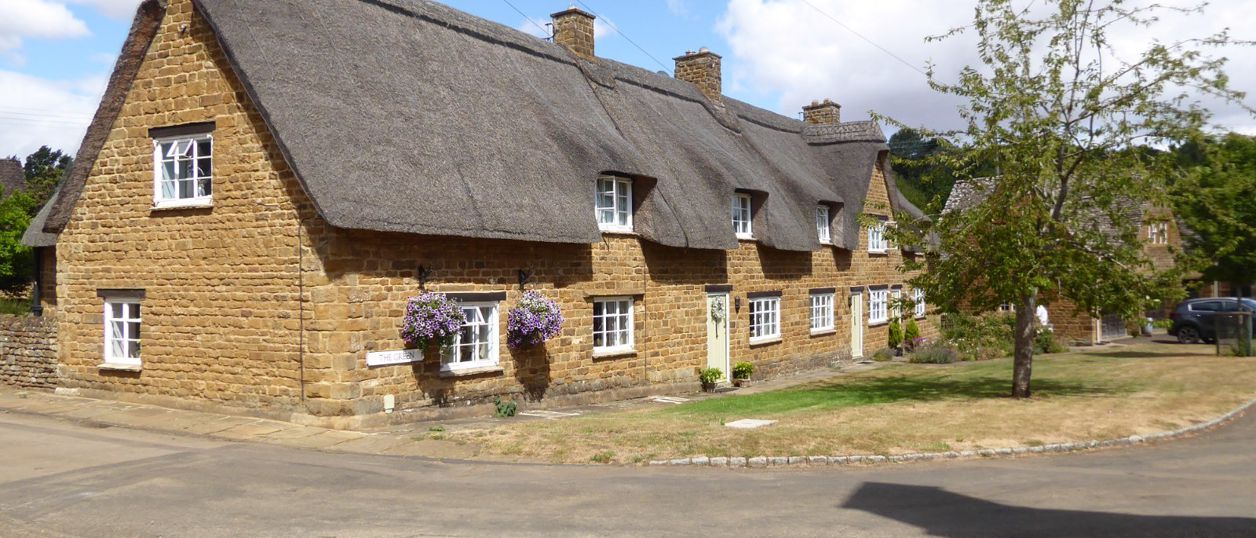
Hornton stone is the rust-brown building stone of the villages around Banbury. It is an iron-rich rock from the Early Jurassic, known to geologists as the Marlstone Rock Formation, and named after the Oxfordshire village of Hornton, where it was quarried for centuries. It is the reason this country looks different from the pale limestone Cotswolds to the south, and why people here talk about the ironstone villages.
What the stone is
The rock is a thin one. The British Geological Survey (opens in a new tab) describes the Marlstone Rock Formation as a mainly iron-rich limestone, sandy, shelly and made of tiny rounded grains in places, up to about 10m thick. It runs across England from Mendip to Market Weighton in Yorkshire.
The colour is chemistry. Fresh stone is blue-green, from an iron mineral called berthierine. When air and water get at it, the iron oxidises to a rich rusty brown. The Warwickshire Geological Conservation Group (opens in a new tab) points to the difference between two sites: the quarry by the A422 at Hornton, where the fresh 'Blue Hornton' shows, and the Edge Hill quarries, where the rock has weathered all through. Spoil heaps at the Hornton quarry still show both, blue-green inside and golden brown on the surface. It is also full of fossils, notably brachiopods, bivalves and belemnites.
A trade journal has described its better form as a mellow yellow-ochre with hints of green. So do not expect one colour: it varies with the bed and with how long the weather has had at it.
Quarrying at Hornton and Edge Hill
Hornton was where the stone trade lived. The Victoria County History (opens in a new tab) finds quarrymen and masons in local wills and registers from 1609, and counts 19 stonemasons, 5 quarrymen and 10 labourers in Hornton in the census of 1851. A pub called the Rock Tavern, recorded in 1854, served mainly quarrymen. The quarries supplied much of the principal building stone for the Banbury and Edgehill districts. Carr's Pit, the last quarry worked at Hornton for the stone itself, closed in 1942.
The trade then moved up the hill. The Stanley firm, based on Edge Hill since the First World War, sold the stone as far as New Zealand and South America, and employed 40 people in 1963. When the Warwickshire Geological Conservation Group looked in 2020, ornamental Hornton stone was on sale at the Edge Hill quarry, with reclamation work under way, while the A422 quarry at Hornton showed no activity.
Moore, Scott and the fine work
The stone had admirers beyond the region. The county history says Gilbert Scott admired it and that several modern sculptors favoured it, Henry Moore among them. Blue Hornton in particular was used for monumental work.
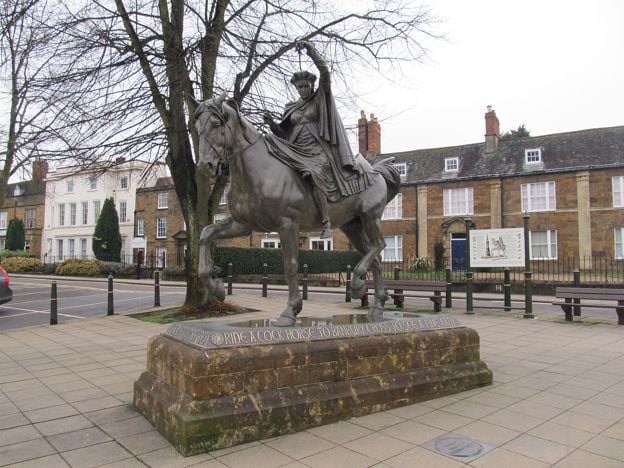
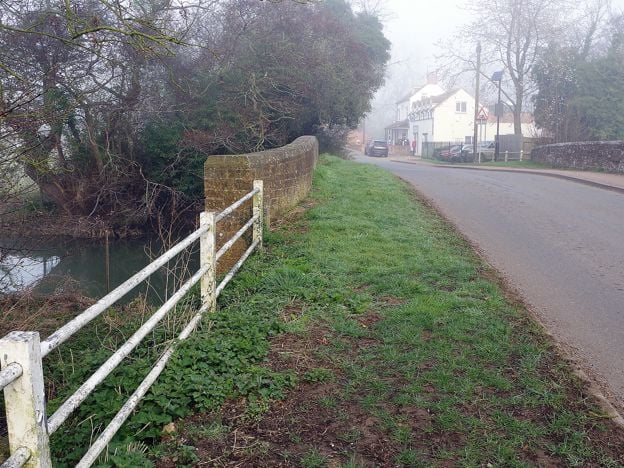
The proof is in the Tate's collection. Moore's _Recumbent Figure_ of 1938 (opens in a new tab), commissioned by the architect Serge Chermayeff, is carved from green Hornton stone, and was then his largest stone sculpture. It went to the Tate in 1939. Closer to home, the plinth of the Fine Lady statue in Banbury is local Hornton stone, unveiled in 2005, and when Cropredy Bridge was rebuilt in 1937 the concrete was faced with it.
Stone for steel
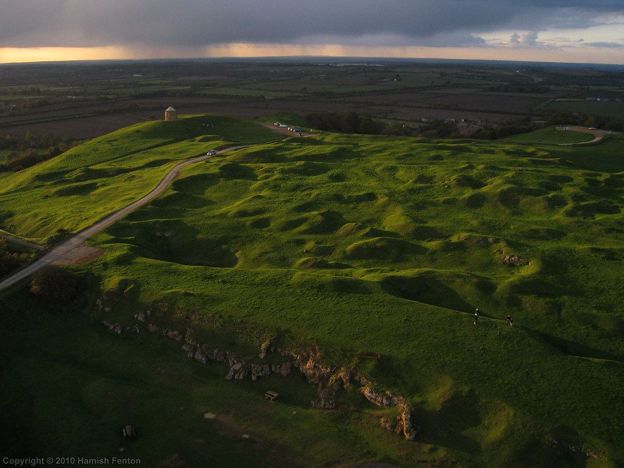
There was a second, rougher trade, which changed the land far more. Marlstone is a low-grade iron ore, and in the First World War the ore mattered more than the masonry. The Oxfordshire Ironstone Company took a lease at Wroxton in 1917 from Christ Church and Trinity College. A Wroxton village history (opens in a new tab) says German prisoners of war built the railway link to the main line at Banbury, in use by 1919.
The scale grew quickly. Output was about 60,000 tons in 1923 and about 30,000 tons a week in the Second World War, with Italian prisoners and Polish immigrants added to the workforce. The village history puts the peak at almost 2 million tons a year, with maximum output in 1956. The county history (opens in a new tab) gives about 30,000 tons an acre, with the land worked in strips and restored as they went, and notes that mining slowed farming improvement in the parish. In 1963 the company employed about 135 to 140 men, down from a peak of 200. It closed in 1967, and the track had gone by the middle of 1968.
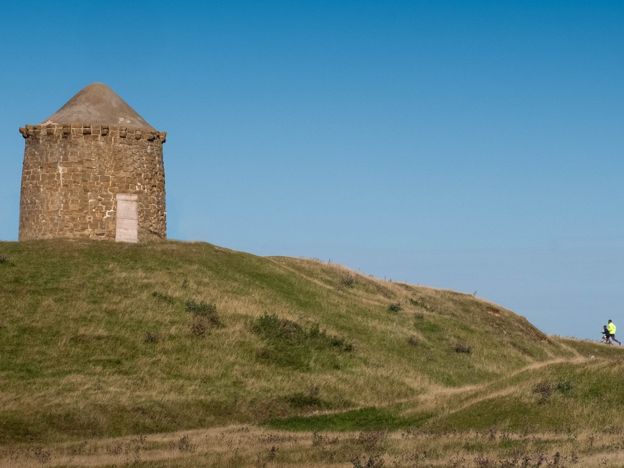
Over the county line a smaller effort ended sooner. The Edge Hill Light Railway, built to carry ore from the top of the ridge down towards Burton Dassett, ran only briefly in the early 1920s. Old workings at Burton Dassett Hills Country Park show what quarrying left behind, in the open.
The Banburyshire newsletter
Events, new places and the best of the season, about once a month. Unsubscribe at any time.
How it behaves in a wall
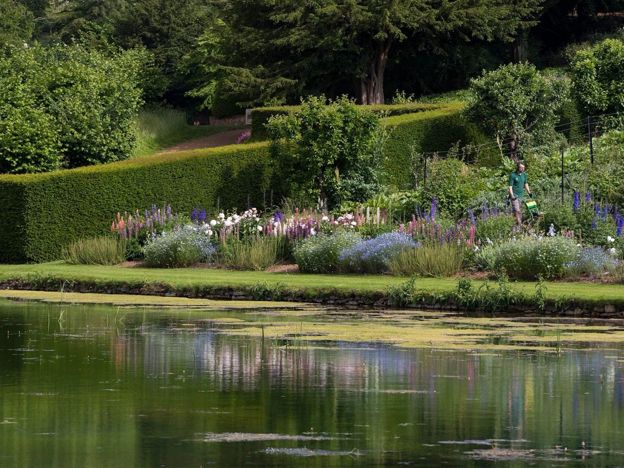
The stone is not as tough as it looks. It was easily dressed, which is why it was used for everything from great houses to barns and field walls. But that softness has a price. An article on the Strategic Stone Study's Warwickshire pilot reported frost and rain damage (opens in a new tab) in the Hornton stone of Upton House and Ashby St Ledgers, with some poor stone used in past repairs. Its author argued that nothing but local stone will match in texture and weathering. That is why a local supply of the stone still matters.
Where to see it
The villages are the point, and the county history is good on the oldest of them. Horley's church has a late twelfth-century tower in Hornton stone, and most of Horley's houses and cottages date from between 1580 and 1640. Hornton's manor house carries the date 1607. In Banbury itself the county history says the soft brown ironstone was the almost universal building material of the eighteenth century.
For a first look, go to Wroxton for its thatch and pond, then North Newington and Broughton, and south to Bloxham and Adderbury. North Oxfordshire has plenty more in our villages near Banbury guide. On the ridge, the tower of the Castle Inn at Edgehill is built of the local stone, and the lanes of Ratley are close by. The working quarries and the old sites are not attractions. Local geological designation gives no right of access, so see them from a public footpath or not at all.
If someone asks you whether this is the Cotswolds, we have an answer to that too.
Mentioned in this story
The places, sights and walks in this story, each with a page of its own: what it is, when to go and how to get there.
-
Upton House and Gardens
Historic houses and heritage
-
Burton Dassett Hills Country Park
Parks and gardens · Burton Dassett
-
Fine Lady statue, Banbury
Sight · Monument · Banbury
-
Cropredy Bridge
Sight · Bridge · Cropredy
Places to stay near Wroxton
-
The Wroxton Hotel
Hotel · Wroxton
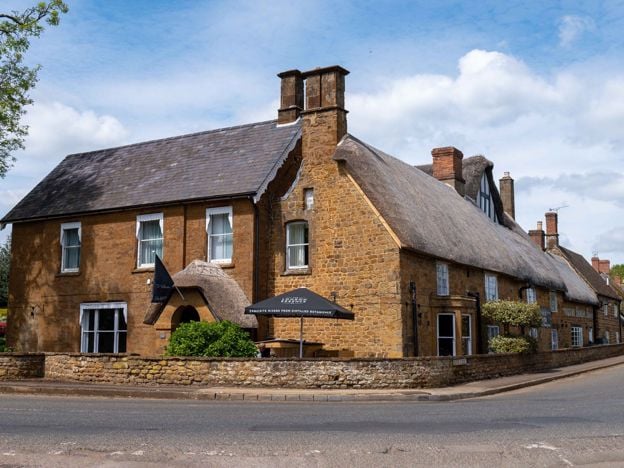
A 32-room hotel made from three adjoining stone cottages, partly dating from 1649, on the edge of thatched Wroxton, a few minutes' drive from junction 11 of the M40, with free parking and its own tea room.
Dog-friendly · Wedding venues
Verified Nov 2026
-
Banbury Cross Bed and Breakfast
B&B · Banbury
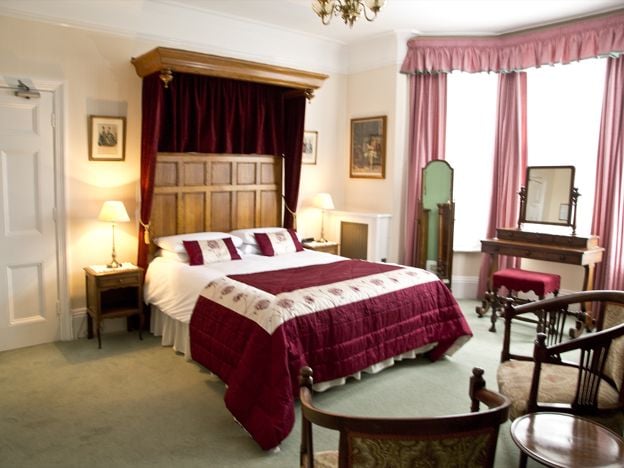
A family-run Victorian B&B on Broughton Road, Banbury, with seven bedrooms, about 370m from Banbury Cross, with free off-road parking, cooked breakfasts and rates from £77. No under-18s.
Car-free
Verified Nov 2026
-
The Three Pigeons, Banbury
Pubs · Banbury
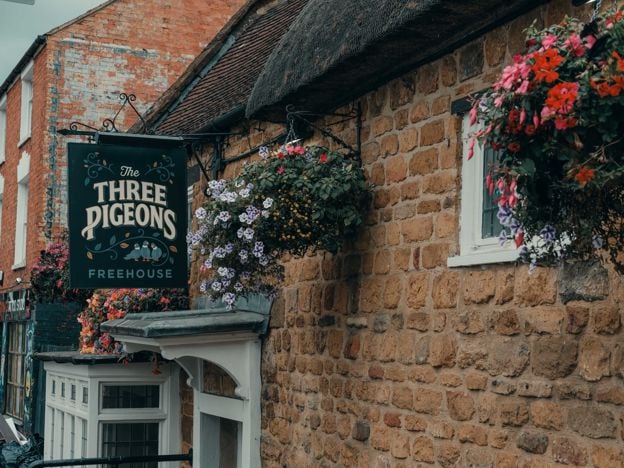
A Grade II listed 17th-century inn, partly thatched, on Southam Road, Banbury, with real ales and ciders, a courtyard, Smash Cow street food from Thursday to Saturday and three en-suite rooms.
Dog-friendly · Car-free
Verified Nov 2026
Read next
-
Is Banbury in the Cotswolds?
Story · Guides · 9 minute read
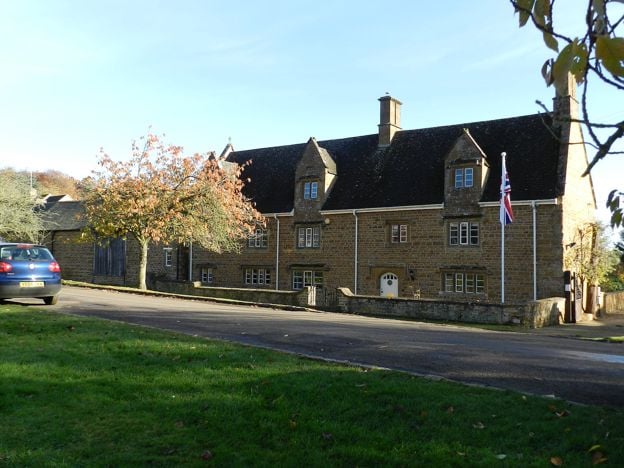
No. Banbury is about 5 miles outside the Cotswolds National Landscape, and it is built of rust-gold ironstone, not Cotswold limestone. Here is where the boundary runs, which villages fall inside it, and how far you have to drive for the Cotswolds.
-
The Civil War in Banburyshire: Edgehill, Cropredy and Banbury's sieges
Story · History · 7 minute read
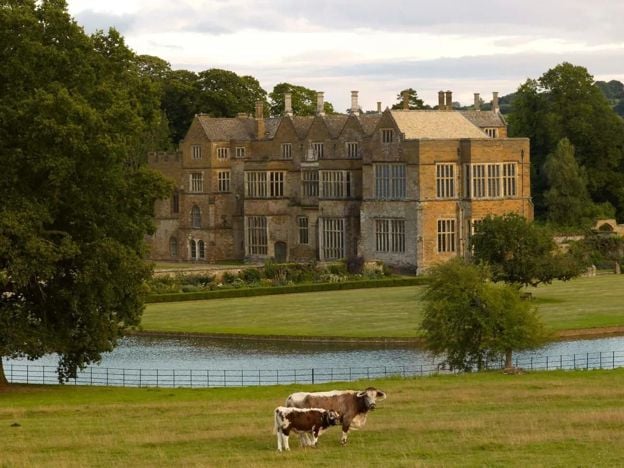
Banburyshire saw the Civil War's first great battle at Edgehill in 1642, a Royalist win at Cropredy Bridge in 1644 and two sieges of Banbury Castle. By 1648 the castle had been pulled down. Banbury lost hundreds of its people, and this is how it happened.
-
Strange Banburyshire: ghosts, witches, lost horses and sham ruins
Story · Strange Things · 6 minute read
The odd corners of the country round Banbury: a ghost battle in the sky over Edgehill, a witch who turned a king to stone at Rollright, a lost red horse, a three-day saint, a priest said to have died of fright, and ruins built to look ruined. Each one told with what is on record.