Motorsport Valley: how Formula One settled around Banbury
In 1948 a farmer got two months to turn an RAF training station into a Grand Prix circuit. Teams, engine makers and engineers followed, and Mercedes, Alpine, Aston Martin, Haas and Cadillac now have Formula One bases within 17 miles of Banbury. This is how it happened, legend kept apart from record.
· 19 minute read
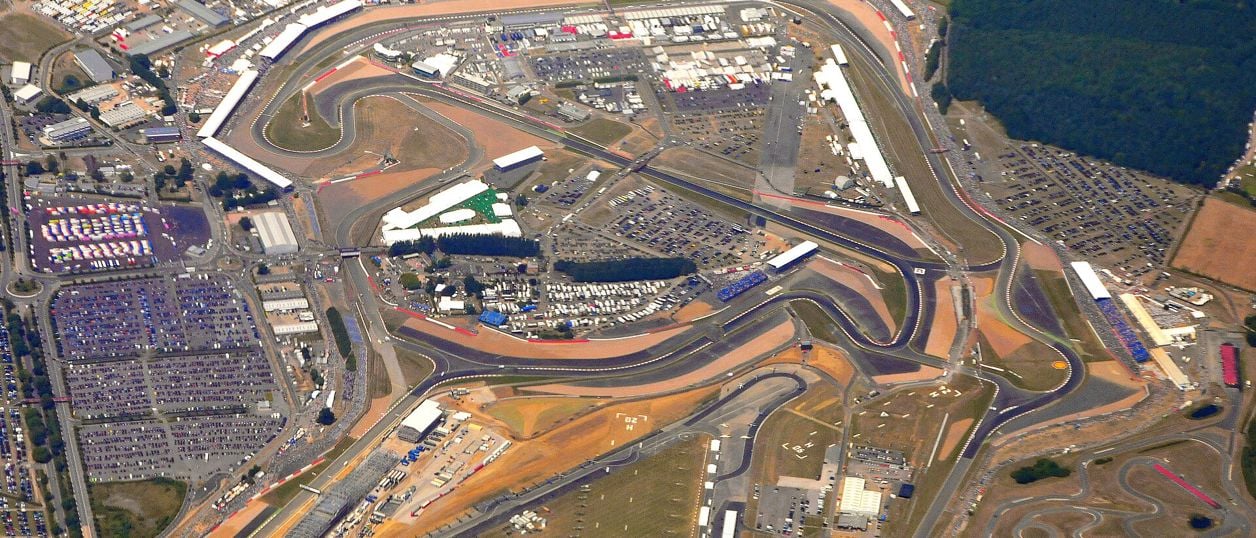
Ten miles (16km) east of Banbury, at Brackley (opens in a new tab), is the factory that built the Mercedes cars that won eight constructors' championships in a row. Thirteen miles south, at Enstone, Benetton and Renault won their world titles. Silverstone, 17 miles away, held the first round of the World Championship in 1950, and Haas runs its European base from Banbury itself. Nobody planned any of this. It grew from a redundant airfield, a pool of engineers who loved racing, and a habit of leaving one team to start another.
The industry's trade body has registered the name Motorsport Valley for it, and you will not find that on a map. This is how it came about, from published sources linked in the text. Where the sources disagree, or where a good story has outrun the record, we say so.
An airfield with nothing to do
RAF Silverstone opened on 20 March 1943 (opens in a new tab), according to Northamptonshire's heritage record, on farmland at the county's border with Buckinghamshire. It was a Bomber Command station, but a training one. No 17 Operational Training Unit taught crews to fly the Vickers Wellington at night, and more than 2,500 people trained there (opens in a new tab) between 1942 and 1944. The Silverstone Museum describes it as a training base, while the county record notes that offensive sorties were flown from it too. It is safest to call Silverstone a bomber training station.
Training was dangerous in itself. A memorial stone to those who died was laid in 1989, and survivors of the unit unveiled it again in 2002 after building work at the circuit forced a move. The museum places it near the Luffield grandstand.
The RAF was finished with the place by about 1946, when the county record has it put on care and maintenance, though Autosport (opens in a new tab) dates the unit's closure to 1947. It left five large hangars, three runways in a triangle and a perimeter track, with nothing to do.
The next part is where the record thins out. That informal racing happened on the airfield by 1947 is on the county record, and Motorsport UK (opens in a new tab) says the same. The story that goes with it is livelier. Maurice Geoghegan (opens in a new tab), who lived in Silverstone village and had a new Frazer Nash, is said to have found the perimeter road and told a few friends. In September 1947 about a dozen of them raced round it, and Geoghegan hit a sheep, which gave the event its name: the Mutton Grand Prix. The accounts we could read come from a watch company's magazine, a tyre company's website and enthusiasts, and they cannot agree on how many cars there were. Enjoy it as a story.
Two months, some oil drums and a farmer
After the war the Royal Automobile Club wanted somewhere to restart top-class racing, and Britain had plenty of airfields and no major circuit. Motor Sport magazine (opens in a new tab) says the choice came down to two: Snitterfield, near Stratford-upon-Avon, and Silverstone. In 1948 the club arranged a lease with the Air Ministry. Had the decision gone the other way, this would be a story about Warwickshire.
The county's record of the circuit (opens in a new tab) says the site then included a cereal farm and a piggery, and that the club gave James Wilson Brown, a farmer, two months to build a Grand Prix track. Motor Sport in 1977 (opens in a new tab) remembered Jimmy Brown as a Scottish former wartime pilot who came for a three-month trial. Both may be true. He stayed for decades and ended up running the Silverstone business. The course was marked out with bales and oil drums on what Motor Sport called a naked airfield.
The RAC International Grand Prix (opens in a new tab) ran on 2 October 1948, two weeks after Goodwood, another airfield, had held its first meeting. The layout used two of the runways and parts of the perimeter, 3.67 miles a lap, for 65 laps and about three hours. Stirling Moss led the 500cc race beforehand until a sprocket broke on his Cooper. The Maseratis of Luigi Villoresi and Alberto Ascari arrived late and started from the back, and finished first and second, 14 seconds apart. Bob Gerard came third in a 13-year-old ERA. The crowd then invaded the circuit so thoroughly that the prize-giving could not happen.
The county record says the first two races used the runways. Later in 1949, for the International Trophy meeting, racing moved onto the perimeter road, the shape Silverstone kept in whole or large part for about 60 years. The British Racing Drivers' Club took over the lease in 1952 and, in 1971, bought the freehold of about 700 acres from the Ministry of Defence. The club still owns it.
13 May 1950
The race that gave Silverstone its place in history had a long name: the Grand Prix d'Europe, incorporating the British Grand Prix, and the first round of the new World Drivers' Championship. King George VI came, with the Queen and Princess Margaret, and the drivers were presented to them. Formula 1's own account (opens in a new tab) has up to 120,000 people at the track, and Motor Sport's report at the time (opens in a new tab) says more than 150,000. Nobody can settle that now.
Twenty-one drivers started, the oldest of them 53. Giuseppe Farina won in an Alfa Romeo after 70 laps, 2.6 seconds ahead of Luigi Fagioli, with Reg Parnell third in another Alfa. Juan Manuel Fangio's Alfa retired, with a broken oil pipe by Formula 1's account and a connecting rod by Motor Sport's. So an English airfield staged the first round of the championship, and Italian cars filled the podium. Britain had the circuit. It did not yet have the industry.
Why the firms came here
No document explains the cluster, because nobody decided on it. The early British racing car makers were not even in this part of the country. Motorsport UK's history (opens in a new tab) puts Cooper in Surbiton and Lotus in north London, and it credits Cooper with starting the whole business. It also offers two reasons why Britain took the lead. A 20mph limit from 1903 meant that nobody could test a fast car on the road, so the country built tracks and later inherited airfields. Wartime aircraft factories taught people to weld, turn metal on a lathe and work soft alloys, which is most of what building a racing car needs. The pattern for what followed was set at Cooper too, the Surbiton garage of Charles Cooper and his son John, an RAF instrument maker in the war. Jack Brabham and Bruce McLaren both worked there before founding their own teams.
The academics who have studied this say much the same thing with more footnotes. Jenkins, Henry and Angus (opens in a new tab), in a 2023 book chapter, trace it from car clubs and hobbyist engineers before 1950, through the specialist constructors of the 1950s, to the aerodynamics and wind-tunnel knowledge that came across from the aircraft industry after 1970.
The motor trade supplied the rest. Chris Aylett, chief executive of the Motorsport Industry Association, told Autosport in 2017 (opens in a new tab) that Britain's post-war car makers each had development engineers who tried ideas out on track at weekends. When those firms closed or merged, they left what he called 'a superb resource of R&D based engineers who loved competition and motorsport'. He speaks for a trade body and it is a flattering account, but the academics tell a similar story.
Then there is what keeps a cluster together once it exists. Racing runs on fast deliveries, and in a small country a supplier can be a short drive from its customer. Geographers Nick Henry and Steven Pinch, in a paper (opens in a new tab) in the journal Geoforum in 2000, described it as a knowledge community, a cluster where what people know is made and passed on within the region. They placed the centre of it all in Oxfordshire.
As for why it drifted north-west from Surrey towards Oxfordshire and Northamptonshire, we could not find a source that sets out a single answer, and we doubt there is one. Our reading is that Silverstone was the fixed point, and that each new firm had a good reason to set up near the people and suppliers already there. That is an inference, and you should treat it as one. The airfields gave racing somewhere to go, but they did not build the factories. The people did that, as the rest of this story shows.
The engine that made a small team possible
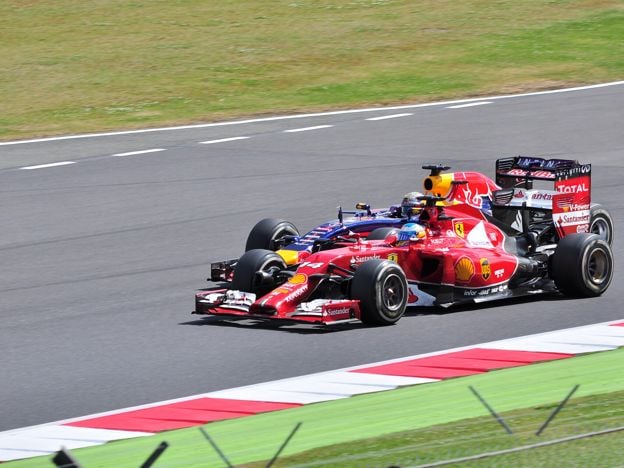
Keith Duckworth and Mike Costin founded Cosworth in 1958 (opens in a new tab) in a north London garage, and the firm moved to Northampton in 1964. Colin Chapman of Lotus then persuaded Ford, through its publicity chief Walter Hayes, to pay for a Formula One engine. The result was the DFV. On 4 June 1967 (opens in a new tab) at Zandvoort, Jim Clark won with it first time out in a Lotus 49.
The DFV went on to win 155 Grands Prix, by the usual count. What matters here is what it did for everybody else. Once a good engine could be bought from Northampton, a new team needed a chassis and some nerve. March and Hesketh, below, both went racing that way. Cosworth is still based in Northampton (opens in a new tab).
It also shows the other habit of the valley. Paul Morgan and Mario Illien left Cosworth to found Ilmor Engineering, with Roger Penske's money, in 1984 by Mercedes' own account (opens in a new tab) (some sources say 1983). Their firm settled at Brixworth, north of Northampton. It became Mercedes' engine maker, and every Formula One engine with a Mercedes badge has come from there since 1995. More than 700 people work on the site.
March at Bicester, and a lord at Easton Neston
Among the first constructors to settle in what is now the middle of the valley was one of the least likely. March Engineering (opens in a new tab) was set up in 1969 by Max Mosley, Alan Rees, Graham Coaker and Robin Herd, whose initials made the name, with £2,500 from each. Motor Sport found them (opens in a new tab) in two large single-storey buildings on the edge of Bicester. Their plan was absurdly ambitious, and it worked for about a season. Ken Tyrrell had no car of his own for 1970, so he bought three March 701s, and Jackie Stewart won the Spanish Grand Prix in one. Chris Amon took another to victory in the non-championship International Trophy at Silverstone. March came third in the constructors' championship that year and never did better. Coaker was the first founder to leave, in 1971, frustrated that Formula One was eating the money from selling customer cars.
March's real legacy was its staff. Ross Brawn started there (opens in a new tab) as a machinist and mechanic in the 1970s. Adrian Newey (opens in a new tab) joined in the early 1980s as a junior draughtsman and came back to design its Formula One cars in the Leyton House years, when the team carried a Japanese sponsor's name. The careers of those two men run through most of the factories in the rest of this story.
So does Harvey Postlethwaite, who left March for one of the oddest teams in the sport's history. Alexander Hesketh (opens in a new tab) was 22 when he began backing a friend's racing in 1972. By 1973 he had a Formula One March with a Cosworth engine, kept in a converted stable block (opens in a new tab) on his family's Easton Neston estate near Towcester, a few miles from Silverstone, and James Hunt, recently dropped from the March Formula 3 team, to drive it. Postlethwaite's own car, the Hesketh 308, won the International Trophy at Silverstone in 1974. In 1975 at Zandvoort, Hunt was first onto dry tyres and held off Niki Lauda's Ferrari to win by 1.06 seconds. By that November, with no sponsor found, the team was wound up. Hunt went to McLaren and was world champion the next year.
Jordan, at the circuit gate
Eddie Jordan, from Dublin, founded Eddie Jordan Racing in 1980 (opens in a new tab) and built up his team through the junior formulas from Silverstone. A new factory (opens in a new tab) went up opposite the circuit in 1991, the year Jordan Grand Prix reached Formula One with a Cosworth engine and a car designed by Gary Anderson and a small team.
Two moments from those years still get told. At the 1991 Belgian Grand Prix, after Bertrand Gachot was jailed, a payment from Mercedes put a young German called Michael Schumacher in the second car. He moved to Benetton straight afterwards. And at Spa in 1998, in the rain, Damon Hill won Jordan's first Grand Prix, with Ralf Schumacher second behind him. The team came third in the championship in 1999, and that was its peak.
The sale came in 2005 (opens in a new tab). After that the names changed faster than the staff did: Midland, then Spyker in 2007, Force India from 2008, Racing Point after administration in 2018, and Aston Martin from 2021. A new campus opened beside the old factory in 2023, and the 1991 building was knocked down that summer to make way for more of it. Eddie Jordan died in March 2025, aged 76. Adrian Newey, who started out at March, joined Aston Martin that same month and was named its team principal for 2026 (opens in a new tab), the year it moved to Honda engines.
Witney to Enstone
Toleman reached Formula One in 1981 (opens in a new tab), working from Witney, and in that first season its two drivers qualified once each. Ayrton Senna took the team's first podiums in 1984. The following year Ted Toleman sold out to the team's sponsor, the Italian clothing firm Benetton, and Gerhard Berger won in Mexico in 1986.
The team moved to the Whiteways site at Enstone (opens in a new tab) around the winter of 1991 to 1992, as it was turning into something serious. Flavio Briatore had signed Schumacher, and Ross Brawn, the former March machinist, arrived as technical director at the end of 1991. With Rory Byrne's cars, Benetton won the drivers' title in 1994 and 1995 and the constructors' title in 1995.
Renault bought the team in 2000 and raced under its own name from 2002, and Fernando Alonso won the drivers' title from Enstone in 2005 and 2006. The 2008 season is remembered for the race-fixing scandal known as crashgate. Genii Capital renamed the team Lotus in 2012, debts piled up, and Renault came back in 2016. It has been Alpine since 2021. The latest turn came when Renault ended its Formula One engine programme (opens in a new tab) after 2025, so for 2026 Enstone's cars carry Mercedes power units from Brixworth, about 45 miles up the road.
Brackley, and the £1 team
The Brackley team traces back to Ken Tyrrell's timber yard in Surrey (opens in a new tab), but in practice it began when British American Tobacco bought Tyrrell in 1997 and set up British American Racing in a new building at Brackley. Craig Pollock and Adrian Reynard (opens in a new tab) were co-founders with the tobacco company, and Jacques Villeneuve was the driver. The team scored no points at all in 1999. Reynard and Pollock fell out, and by 2002 both had gone. Reynard's own racing car company went into receivership that March.
David Richards of Prodrive, down the road in Banbury, became team principal in 2002 (opens in a new tab). Under him, in 2004, Jenson Button finished third in the championship and the team finished second, without winning a race. Honda took full ownership in late 2005 and Button won for it in 2006. Then came the financial crisis. Honda announced at the end of 2008 that it was leaving at once, with the 2009 car already under way.
Ross Brawn had come back from Ferrari and a sabbatical to run the team. He bought it in a management buyout for a reported £1, with Honda paying a final year's running costs, and put Mercedes engines in the car. Brawn GP won both world championships in 2009, its only season, and Button was champion. Mercedes bought in for 2010, and from 2014 to 2021 its team won eight constructors' titles in a row, with seven drivers' titles. More than 950 people (opens in a new tab) now work on the Brackley site, about 10 miles from Banbury Cross.
Banbury's own: Prodrive, Marussia and Haas
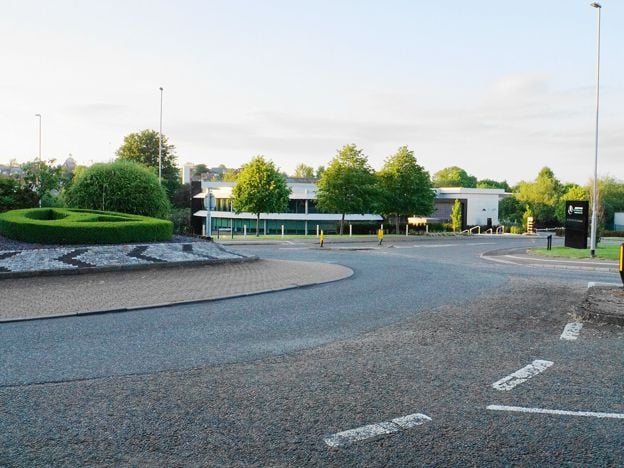
Banbury's oldest name in all this is not a Formula One team. David Richards, co-driver to the 1981 world rally champion Ari Vatanen, and Ian Parry turned their business into Prodrive in 1984, and the company's own history (opens in a new tab) has it moving to Banbury in 1986. It ran Subaru's rally team, with drivers' titles for Colin McRae in 1995, Richard Burns in 2001 and Petter Solberg in 2003, and its Aston Martins won their class at Le Mans in 2007 and 2008. Autosport (opens in a new tab) put the workforce at almost 700 in 2024. Prodrive tried twice to enter Formula One under its own name, for 2008 and for 2010, and neither attempt reached the grid.
The Formula One team came to Banbury by a more painful road. A factory there started as Ascari's race and road car works (opens in a new tab), passed to Wirth Research for Virgin Racing's computer modelling, and then to Virgin's successor, Marussia. The team that started as Virgin in 2010 rarely troubled anyone. Then at Monaco in 2014 Jules Bianchi finished ninth and scored its first points, which by the team principal's later account kept it alive (opens in a new tab). In October that year Bianchi crashed at Suzuka, and he died of his injuries in July 2015. Marussia went into administration on 27 October 2014, and its 200 staff were made redundant (opens in a new tab) in November.
Gene Haas bought the building (opens in a new tab) that winter, though not the team, as a European base for the American entry that began racing in 2016. Marussia itself was rescued and raced on as Manor, also from Banbury, until it stopped trading in January 2017 (opens in a new tab) with more than 200 jobs gone. That is two Formula One collapses in one town in a little over two years, which is the side of this business that does not make the brochures. Haas stayed. Its team principal says most of its engineers are in the UK (opens in a new tab). In 2026 it raced as TGR Haas, with Toyota Gazoo Racing as title partner, and a simulator of its own was being built at Banbury, due to come online in the middle of the year.
Milton Keynes, a second airfield, and who is where
Jackie Stewart and his son Paul set up Stewart Grand Prix (opens in a new tab) at Milton Keynes for 1997, with Ford engines. Johnny Herbert won its only race in 1999, Ford bought the team and called it Jaguar, and Red Bull bought it in November 2004. Newey joined in 2006 and stayed for the best part of two decades. Red Bull Powertrains (opens in a new tab) is on the same campus, building the Ford-badged power units of 2026. Red Bull's sister team has its headquarters at Faenza in Italy, but it ran aerodynamics from a small unit at Bicester (opens in a new tab) from 2009, and in 2025 moved them to Milton Keynes (opens in a new tab).
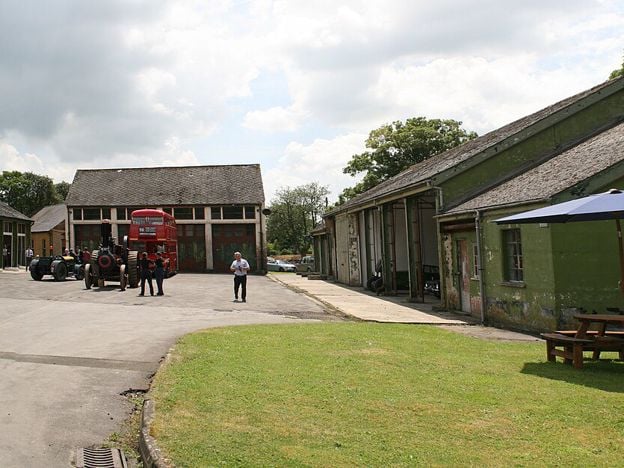
Bicester is where this story comes back to the beginning. RAF Bicester (opens in a new tab), 444 acres of another bomber training station, lay neglected for about 40 years and was on Historic England's at-risk register by 2008. It was bought in 2013 and is now Bicester Motion, home to classic car specialists and the sport's governing body in Britain. In July 2025 Sauber opened a technology centre there (opens in a new tab), in Building 123, ahead of becoming Audi's works team, and the stated aim was to attract engineering talent. A Swiss team owned by a German car maker came to a wartime airfield in Oxfordshire to hire people.
Team bases change, so here is the picture as reported in April 2026 (opens in a new tab), with road distances from Banbury:
- Banbury: Haas's European base, and Prodrive, which is not a Formula One team
- Brackley, 10 miles: Mercedes
- Enstone, 13 miles: Alpine
- Silverstone, 17 miles: Aston Martin, and Cadillac's UK base (opens in a new tab), from which it planned to run most of its first season while its Indiana headquarters was finished
- Bicester, 17 miles: Audi's UK technology centre (its headquarters is at Hinwil in Switzerland)
- Northampton, 29 miles: Cosworth, with Mercedes' engine works at Brixworth just beyond
- Milton Keynes, 31 miles: Red Bull, and Racing Bulls' aerodynamics team
Williams at Grove, about 40 miles away, and McLaren at Woking are further out. You will see the valley stretched to cover both, and sometimes all the way to the West Midlands. The old claim that most Formula One teams are a short drive from Banbury depends on how long you are prepared to drive, though five of the 11 (Haas, Mercedes, Alpine, Aston Martin and Cadillac) are within 17 miles.
What the region gets from it
The big numbers are real but need handling with care. A review by Grant Thornton for the Motorsport Industry Association (opens in a new tab) put UK motorsport turnover at £16 billion in 2023 and employment at 50,000, with 14% of turnover spent on research and development and 89% of companies earning something from exports. It covers the whole of the UK, and a trade body paid for it. Ten businesses in the Formula One group, including seven teams and Silverstone itself, accounted for over £3.8 billion.
The race has its own numbers. Formula 1's figures, published in July 2026 (opens in a new tab), claim more than £100 million a year for the local economy from the British Grand Prix and £12 billion a year for the UK from the sport, with no method given. The last detailed study we could find (opens in a new tab), of the 2002 race, was done by the association for three regional development agencies. It found £34.7 million of spending, 1,148 full-time-equivalent jobs across the UK, 403 of them local, and £5.6 million of income within 50 miles of the circuit. The two cannot be compared directly. The years are far apart, the crowd has grown (351,000 over the weekend in 2019 (opens in a new tab), according to the local MP, and about 500,000 in 2025), and different people did the counting.
The surer evidence is on payrolls. Mercedes reports more than 950 people at Brackley and more than 700 at Brixworth, and Prodrive had almost 700 in Banbury. Those are skilled engineering jobs in small towns. Colleges follow them: Silverstone UTC (opens in a new tab) opened in 2013 with high-performance engineering among its specialisms, and Banbury's college (opens in a new tab) has a centre for it. Oxfordshire's industrial strategy (opens in a new tab) of 2019 lists motorsport among the county's strengths.
What we could not find is a published figure for Banbury or for Cherwell district, so we cannot tell you how many jobs in this town depend on racing. Nor is it all gain. Silverstone itself warns of busy roads on Grand Prix weekend, and the factories bring little in the way of tourism, because you cannot walk into them.
The Banburyshire newsletter
Events, new places and the best of the season, about once a month. Unsubscribe at any time.
If you want to go
Silverstone is the place to start, and the museum is the one part of this history built to be visited. The Silverstone Museum stands at the circuit, with an RAF section, the cars, and a heritage track trail. It opens most days, with free parking; check its opening calendar before you go, and its listing has the current hours and prices. The 17 OTU memorial near the Luffield grandstand is the quiet end of the whole story, though we have not confirmed how easily you can reach it on a day with no racing.
For the race itself, the British Grand Prix falls on a weekend in early July. Our British Grand Prix guide covers tickets, roads and what you may bring, where to stay for Silverstone compares the camping and Escapade with hotels and a base in Banbury, and Silverstone by train explains the Grand Prix shuttle buses from Banbury.
The Grand Prix is not the only meeting. Silverstone's events page (opens in a new tab), as read in November 2026, listed for the next season the World Endurance Championship in April, the BRDC Classic in late July, British GT and MotoGP in August, CarFest at the end of August, the European Le Mans Series in early September and the British Touring Cars later that month. These move, so check the page before you book.
The factories are workplaces. We found no regular public tour at most of them. The exceptions we could find are these:
- Red Bull at Milton Keynes has sold paid factory tours (opens in a new tab) on set dates, and they are not cheap
- Prodrive in Banbury runs pre-booked guided tours (opens in a new tab) on Wednesdays and Fridays, for 10 to 16 people, at £50 an adult when we checked; there are no walk-ins
- Bicester Motion holds Scramble days (opens in a new tab), with workshop visits and a heritage trail through its listed buildings; when we checked in November 2026, the next was listed for a Sunday in January
- Williams says its factory is not open for casual visits, but it runs race-day events and guided heritage collection tours in its Experience Centre at Grove (opens in a new tab)
Banbury makes a practical base for any of this, with the M40 at its edge and trains to London and Birmingham. The Banbury guide and things to do in Banbury cover the town, and the planning pages cover getting here. If you are at Silverstone with an afternoon to spare and no interest in engines, Sulgrave Manor and Canons Ashby are both on the Banbury side.
Places to stay near Banbury
-
Whately Hall Hotel, Banbury
Hotel · Banbury
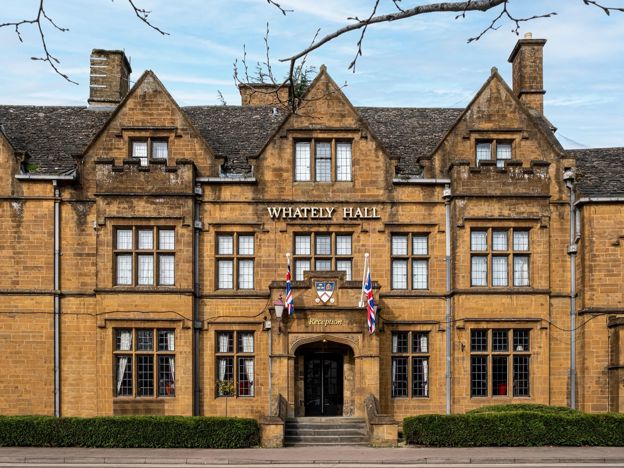
A Grade II listed 17th-century inn, now a 71-room hotel on Horse Fair in the middle of Banbury, with gardens, an oak-panelled restaurant and six EV chargers.
Dog-friendly · Family-friendly · Wedding venues
Verified Nov 2026
-
The Three Pigeons, Banbury
Pubs · Banbury
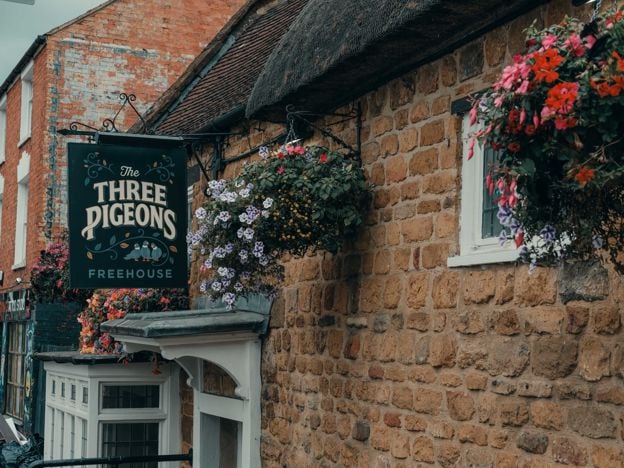
A Grade II listed 17th-century inn, partly thatched, on Southam Road, Banbury, with real ales and ciders, a courtyard, Smash Cow street food from Thursday to Saturday and three en-suite rooms.
Dog-friendly · Car-free
Verified Nov 2026
-
Banbury Cross Bed and Breakfast
B&B · Banbury
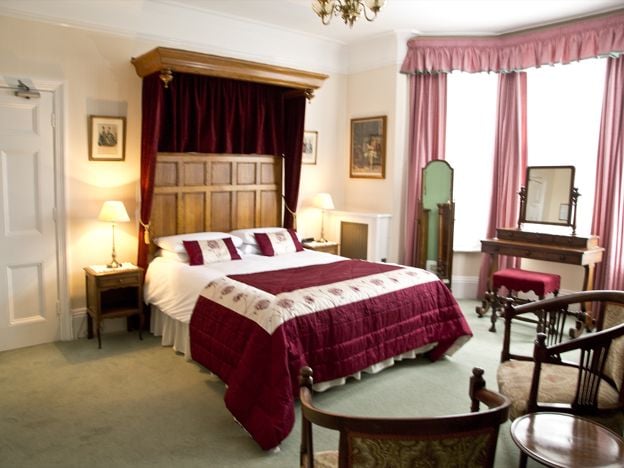
A family-run Victorian B&B on Broughton Road, Banbury, with seven bedrooms, about 370m from Banbury Cross, with free off-road parking, cooked breakfasts and rates from £77. No under-18s.
Car-free
Verified Nov 2026
Read next
-
Day trips from Banbury
Story · Guides · 11 minute read
The best day trips from Banbury: Oxford by train in under half an hour, Warwick Castle, Stratford-upon-Avon, Blenheim Palace, Bicester Village, Silverstone and the Cotswolds, with how to get there, what it costs and which are not worth doing by car.
-
Banbury's First World War munitions factory: National Filling Factory No 9
Story · History · 5 minute read
National Filling Factory No 9, east of Banbury, filled shells from April 1916 and employed about 2,000 people at its height. The M40 now cuts through it. About three quarters of its plan survives as earthworks, protected as a scheduled monument, on private land.
-
Things to do in Banbury
Story · Guides · 13 minute read
Things to do in Banbury: the Cross and the Fine Lady, the Thursday and Saturday market, the free museum and Tooley's boatyard on the canal, then Broughton Castle, Upton House and the brewery at Hook Norton, with what it costs and what to skip.