The original Banbury cake: its history and Gervase Markham's recipe
In Gervase Markham's recipe, a Banbury cake took four pounds of currants and an hour's kneading. Here is the story of the cake and the Parsons Street shop that sold it, and a way to make it at home.
· 6 minute read
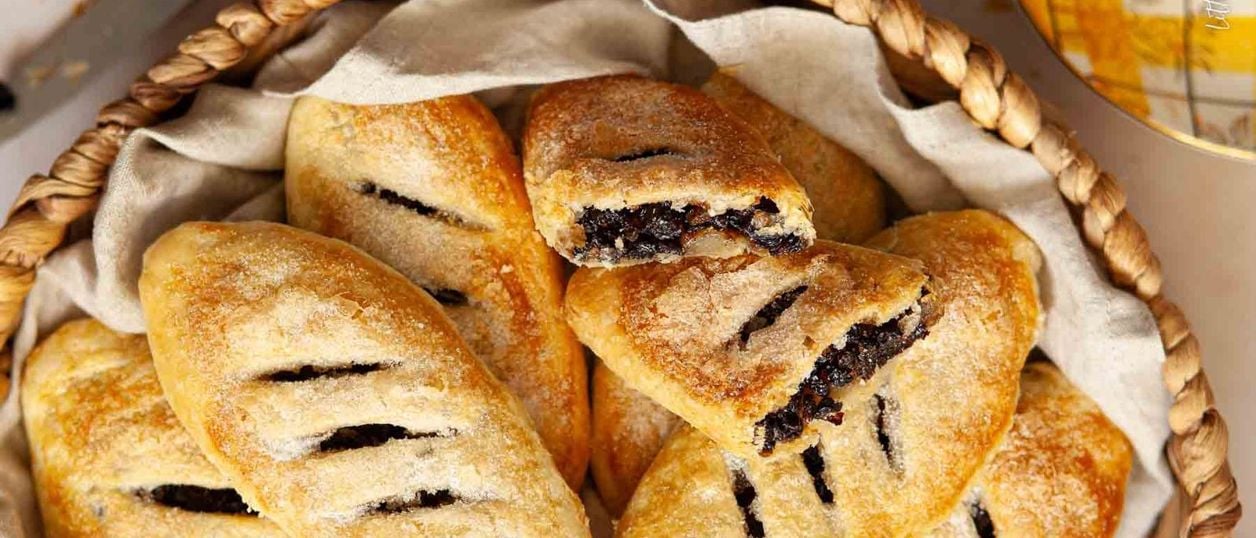
A Banbury cake is a small oval of pastry around spiced currants, and it has been the town's calling card for more than 400 years. The oldest printed recipe we have found, in a household book first published in 1615, is something else: a rich yeasted dough, with the fruit worked in and thin plain dough around it. Both versions are below, with what the records say about the cake and what they do not.
Cheese, cakes and zeal
The earliest record we have found is a joke. The 1610 English translation of William Camden's Britannia says Banbury was noted for its 'cheese, cakes, and zeal' (opens in a new tab), the zeal being the town's puritanism. The Latin original mentions only the cheese, so the cakes and the jibe were the translator's addition. Ben Jonson's comedy Bartholomew Fair makes its puritan, Zeal-of-the-Land Busy, a Banbury man and a former baker who gave up his trade because his cakes were served at bridals, maypoles and morris dances. The two jokes belong together, because this was the town that had just pulled down its own cross.
By then the cake was fit for royalty. The Victoria County History records that James II was given one in 1687, carried by four men, which gives you some idea of the size, and that the Prince and Princess of Wales were presented with one in 1739. The gift lasted into the railway age. Sarah Beesley's memoir, My Life, has the Mayor's daughter handing Queen Victoria flowers and Banbury cakes at the station in November 1866, during a five-minute stop.
What is legend
You will read that crusaders or Knights Templar brought the spices home, and that the cakes were made to a secret recipe from 1586. We have found no source for either, and the date comes with no citation on any page where we have seen it. George Washington's fondness for them has no source that we can find either. Treat all of these as stories.
You will also read that Edward Welchman began making the cakes at the Sign of the Unicorn in Parsons Lane in 1638. Welchman was a real man, a principal burgess of the town in the seventeenth century, but we have not found a record that ties him to the cakes, so treat that as unconfirmed too.
The Original Cake Shop
The shop in Parsons Street is far better documented, and the Banbury Historical Society gave it an obituary in its journal in 1967 (opens in a new tab) when it closed after possibly three centuries of trading. The name 'original' was in use by 1833. Alfred Beesley's history of 1841 says the cake was already thought old-fashioned in the eighteenth century.
Betty White, who ran the shop with her husband Jarvis in the eighteenth and early nineteenth century, comes down to us complaining. When customers said the cakes were smaller, Beesley records, she told them that currants, butter and sugar were all double the price they used to be. She wondered aloud how much butter and sugar they thought could be bought for a ha'penny. Jarvis, an idle man by Beesley's account, tried to prove how light the cakes were by claiming a sparrow had flown off with one.
The Rutter family followed, and Samuel Beesley, a baker, took over in 1818 and ran it until his death in 1843. A later article in the same journal says he apparently sold an average of 5,400 cakes a week, and there was a substantial trade with India by 1841. The Lamb family had it until 1872, when the Browns took over. Mrs and the Misses Brown ran the place through the Victorian years with a firmness people remembered for decades. The shop closed in May 1967. The building was sold to a developer, demolition began in the spring of 1968, and a preservation order made on 8 April came too late: the roof was already off. After a public inquiry the Minister declined to confirm the order, and by the autumn of 1968 nothing of the shop remained.
Markham's recipe
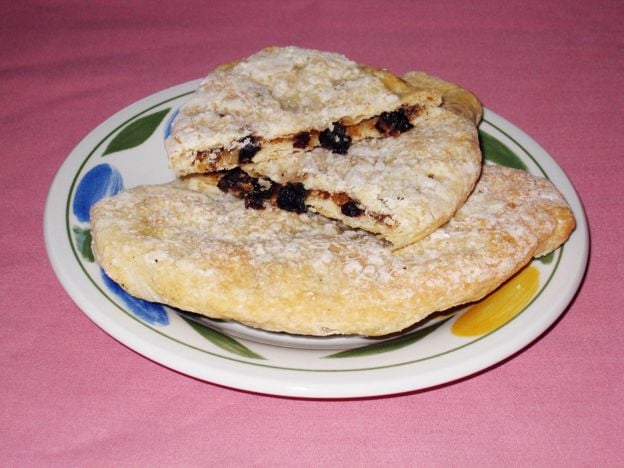
Gervase Markham's The English Huswife, first published in 1615, has the oldest printed recipe we have found (opens in a new tab), in its section on banqueting. The text we worked from is a later edition, of 1683. It is written for a big household. He takes four pounds of currants, washed, picked and dried in a cloth. He beats three eggs, leaving out one yolk, and strains them with ale barm (the yeast from brewing), cloves, mace, cinnamon and nutmeg. He warms a pint of cream with a pint of that morning's milk until the chill has gone. Flour goes into a bowl with plenty of cold butter and sugar, in amounts he does not state, then the eggs and the warm milk go in, and the whole is worked for an hour or more.
Then comes the clever part. He holds back some dough with no fruit, works the currants into the rest, shapes cakes of any size you like, and rolls the plain dough thin to cover each cake top and bottom. They bake according to their size. He gives no temperature, no time and no finish.
The recipes that followed move towards what we know. The Compleat Cook of 1658 calls for currants, sugar, butter, mace, cloves, ale yeast and rosewater, and by the time you reach the modern shop cake, the Foods of England project describes hand-sized ovals of puff pastry filled with spiced currants.
A recipe worked from Markham
This is our own working of Markham's method at a household size. The currants, the equal cream and milk and the spices are his. The flour, butter and sugar he leaves open, and those amounts, the modern yeast and the oven are ours. It makes eight cakes. You will need:
- 350g strong white flour
- 100g cold butter, cubed
- 50g caster sugar
- 7g sachet of fast-action dried yeast
- 1 large egg, beaten
- 80ml double cream
- 80ml whole milk
- 225g currants, washed and dried in a clean cloth
For the spice, use half a teaspoon each of ground cinnamon and nutmeg and a quarter of a teaspoon each of ground cloves and mace. Markham gives no amounts for these, so taste the dough raw and suit yourself.
Warm the cream and milk until just tepid, as he says, so the chill is gone.
Rub the butter into the flour, then stir in the sugar, yeast and spice. Add the egg and the warm cream and milk and knead for about 10 minutes. Modern yeast and strong flour save you most of Markham's hour. Cover and leave somewhere warm until doubled in size, about an hour.
Knock the dough back and cut off a third. Work the currants into the larger piece, divide it into eight and shape each into a flattened oval.
Roll the plain dough as thin as you can, cut ovals to fit, and lay one under and one over each cake, pinching the edges to seal. Prove on a lined tray for 30 minutes, then bake at 190C (170C fan, gas mark 5) for 20 to 25 minutes until well browned. Cool on a rack. Expect something closer to a rich fruited bun than a pastry.
The Banburyshire newsletter
Events, new places and the best of the season, about once a month. Unsubscribe at any time.
The puff pastry version
For the modern form of the cake, use the same spice with shop-bought all-butter puff pastry. Melt 40g butter with 40g soft brown sugar, stir in 225g currants, the spice and a teaspoon of rosewater (from the 1658 recipe), and leave it to cool.
Cut the rolled pastry into 10cm rounds, put a spoonful in the middle of each, draw the edges together and seal. Turn them over, press into ovals, cut three short slashes in the top, brush with egg white and scatter with sugar. Bake at 200C (180C fan, gas mark 6) for about 20 minutes until golden. Cool on a rack.
Finding one in Banbury
We have not listed a bakery here, because we know of no local seller in November 2026: Brown's Original Banbury Cakes Limited, the last firm we know of that made them in the town, was dissolved in April 2026. The Parsons Street shop is gone, and how the cake faded from its own town is a story of its own: how the Banbury cake disappeared. For the town itself, Banbury Museum and Gallery tells the wider story, and our list of things to do in Banbury covers the rest of a day there.
Mentioned in this story
The places, sights and walks in this story, each with a page of its own: what it is, when to go and how to get there.
-
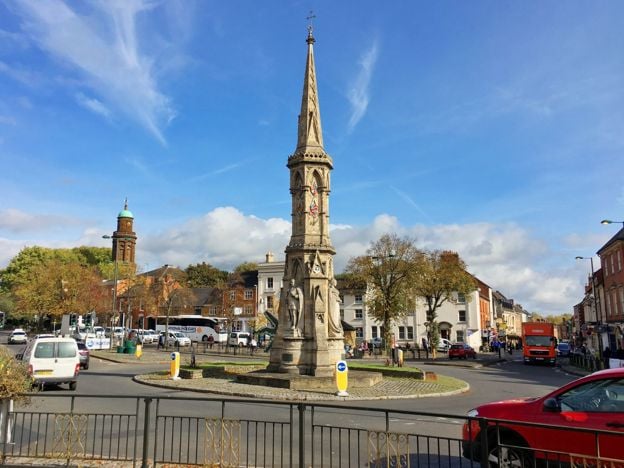
Banbury Cross
Sight · Monument · Banbury
Places to stay near Banbury
-
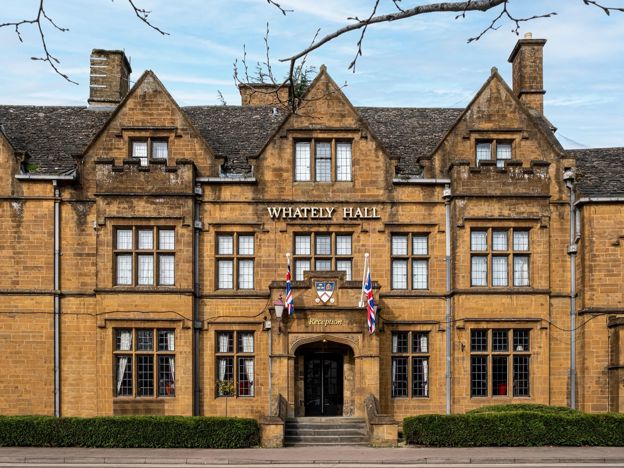
Whately Hall Hotel, Banbury
Hotel · Banbury
A Grade II listed 17th-century inn, now a 71-room hotel on Horse Fair in the middle of Banbury, with gardens, an oak-panelled restaurant and six EV chargers.
Dog-friendly · Family-friendly · Wedding venues
Verified Nov 2026
-
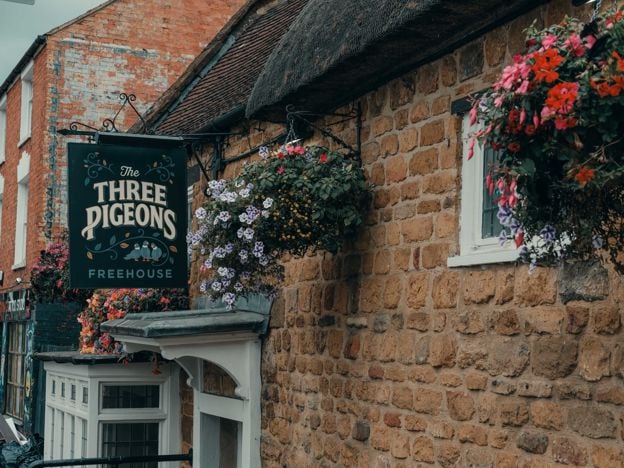
The Three Pigeons, Banbury
Pubs · Banbury
A Grade II listed 17th-century inn, partly thatched, on Southam Road, Banbury, with real ales and ciders, a courtyard, Smash Cow street food from Thursday to Saturday and three en-suite rooms.
Dog-friendly · Car-free
Verified Nov 2026
-
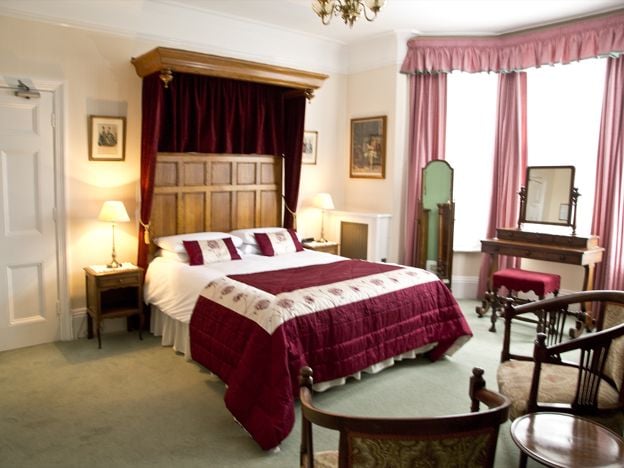
Banbury Cross Bed and Breakfast
B&B · Banbury
A family-run Victorian B&B on Broughton Road, Banbury, with seven bedrooms, about 370m from Banbury Cross, with free off-road parking, cooked breakfasts and rates from £77. No under-18s.
Car-free
Verified Nov 2026
Read next
-
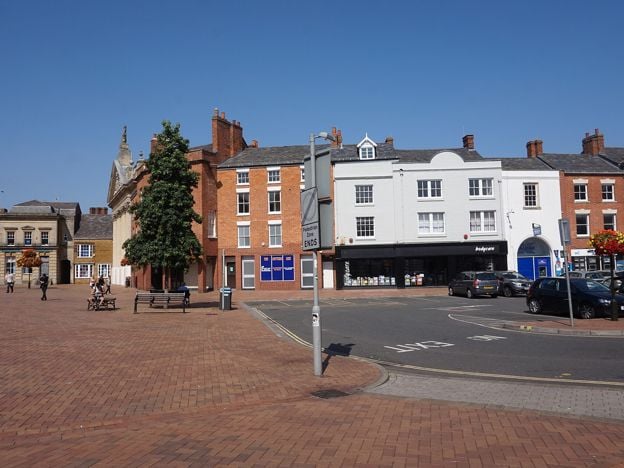
Things to do in Banbury
Story · Guides · 13 minute read
Things to do in Banbury: the Cross and the Fine Lady, the Thursday and Saturday market, the free museum and Tooley's boatyard on the canal, then Broughton Castle, Upton House and the brewery at Hook Norton, with what it costs and what to skip.
-
Banbury Michaelmas Fair: from hiring fair to street funfair
Story · History · 5 minute read
Banbury's Michaelmas Fair fills the town centre for four days each October. Records show fairs here from 1154, a hiring fair called the Mop by 1677, and a pleasure fair that outlived its purpose. This is that history, and how the fair runs today.
-
Alcan in Banbury: the aluminium works that made a market town industrial
Story · History · 6 minute read
In 1931 the Northern Aluminium Company opened a works on the Southam Road, and Banbury stopped being only a market town. It rolled sheet for wartime aircraft behind a decoy factory, employed over 3,000 at its height, became Alcan and closed in 2009.