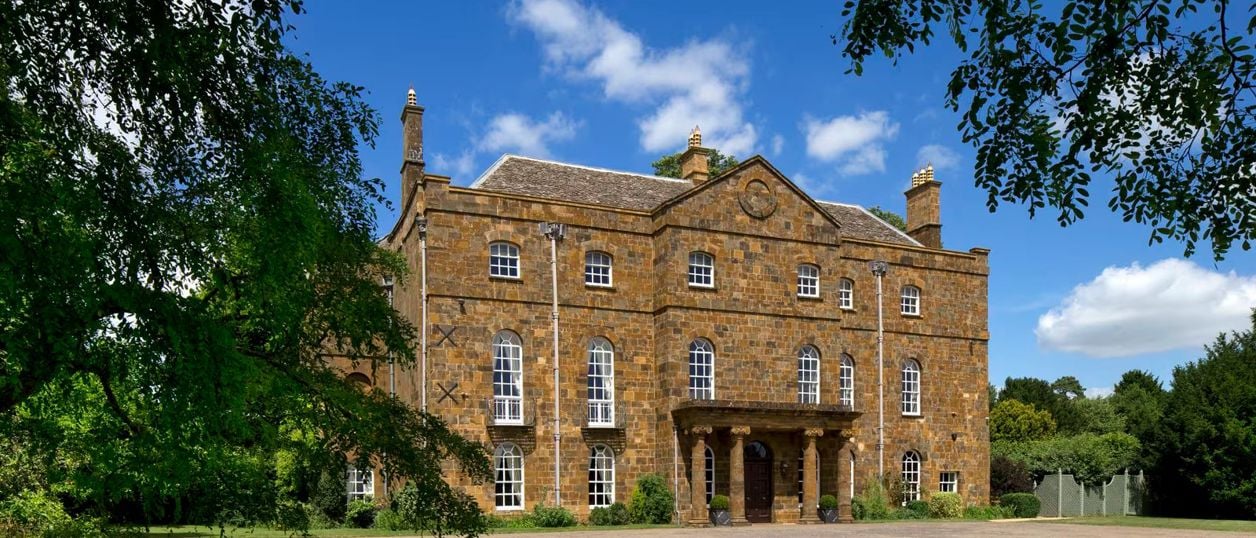
Adderbury House
A private house in Adderbury and what is left of a mansion of the Earls of Rochester and the Dukes of Argyll and Buccleuch. Most of it was pulled down in 1808, and it was enlarged again after 1891. Grade II and not open. Its old water is now the public Adderbury Lakes.
Historic building
AdderburyAdderbury House is a large private house in East Adderbury, south of Banbury, and it is not open to visitors. It is what survives of a mansion that passed through the hands of the Rochesters and two dukes, and it is listed Grade II. Come to Adderbury for the church and the lakes, and know whose landscape they sit in.
The story of Adderbury House
The estate was leased from the Bishop of Winchester, and the first big spender was a widow. Ann, Countess of Rochester, renewed the lease in 1661 and is said to have spent £2,000 on the building, furniture and gardens, grafting new rooms onto the old house. She was the mother of John Wilmot, the second Earl of Rochester, the Restoration poet and libertine, and the Victoria County History calls it the Wilmots' house. Robert Plot in 1676 counted it among the county's 'most stately buildings'. An inventory of 1678 lists the great and little halls, a drawing room, a great room, a great square chamber, a lesser dining parlour and 11 other rooms.
Argyll and Buccleuch
John Campbell, Duke of Argyll, took the lease in 1717 and rebuilt in stages. The Victoria County History says the south front was remodelled probably in 1722, and that James Gibbs designed an entrance front that was never built. Arcaded wings by Roger Morris followed from 1731, one of them holding a gallery of about 24m. The Victoria County History adds that the duke had the mill in East Adderbury moved because it got in the way of the landscaping of his grounds.
On Argyll's death in 1743 the house passed through his daughter Caroline to her son Henry, Duke of Buccleuch. He was reported to be 'carrying on great works' in 1768, with Sir William Chambers the probable architect, and he later asked Capability Brown for a design for altering the park and gardens. The grounds were laid out and the road moved at inclosure in 1768, and the vicar wrote in 1796 that 90 cottages had gone. It was sold in 1774 with 56 rooms. Horace Walpole thought it large and inconvenient.
Cut down and built up
In 1808 J. E. Field, who had bought the estate, pulled most of it down. The central block went, leaving the south front with a new porch. The house took its present size after J. W. Larnach bought it in 1891 and enlarged it, adding the pedimented centre with its Ionic portico on the south front. Only the stable block, the north arcade and the south front of the old mansion survive.
Oxfordshire County Council bought the house and grounds in 1948 for an old people's home, which is how the Historic England listing still describes it, in text last amended in 1988. It has since gone back to private hands: Country Life reported that the house and its 45 acres (about 18 hectares) of parkland were sold into private ownership in 1992, and that it was on the market in November 2023 at £14 million. The DiCamillo Companion, a register of country houses, records it as a private home. We found no report of that sale's outcome and do not name an owner.
What to look for
The listing describes a courtyard house of marlstone ashlar under Stonesfield slate, three storeys high, with a Rococo plaster ceiling, a late eighteenth-century stair and vaulted cellars inside. None of that can be seen by the public. The stable court, about 50m south-west, and an entrance arch of about 1770, about 60m west and possibly by Chambers, have their own listings.
The part of the old estate a visitor can actually walk is Adderbury Lakes (opens in a new tab). The parish council owns this Local Nature Reserve, two lakes in woodland that it describes as a nineteenth-century garden of Adderbury House, restored in the 1980s. It has three parking spaces on Lake Walk, asks for dogs on a short lead, shuts in darkness and may close in high winds. Paths are mostly wheelchair accessible, the parish says, but mind the deep water and the mud.
Visiting
You cannot visit. We found no open days, no tours and no permitted path to the house, so please do not go up the drive. Anything you see of it is whatever the public road gives you, and that is not worth a special trip. Adderbury itself is worth one, for St Mary's Church, listed Grade I, and for the lakes.
Getting there
Adderbury is on the A4260 about 3 miles south of Banbury. There is no village car park, and the council's leaflet suggests the south side of The Green. The Stagecoach S4 runs roughly hourly by day between Banbury and Oxford, about 20 minutes from Banbury, with fewer on Sundays.
Nearby
Our guide to Adderbury covers the village, including the Quaker meeting house and the tithe barn. For a meal, The Bell and The Red Lion are both in the village. Henry Warriner's windmill stands on the high ground towards Bloxham, and our guide to the villages near Banbury puts Adderbury in context.
Walks past Adderbury House
-
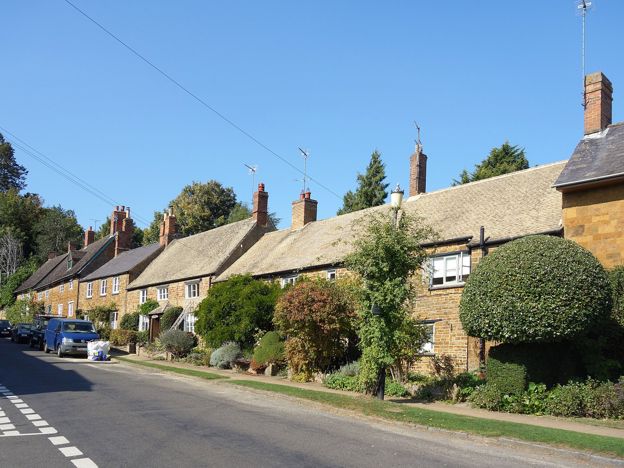
Adderbury and Bloxham Grove
Walk · Starts in Adderbury · 1 hr, 30 mins · Circular
A 3.1-mile (5.1km) circular walk from the Methodist church in East Adderbury, about an hour and a half of easy walking with stiles. Field paths lead to Bloxham Grove and its small windmill, down to Lower Grove Mill on the Sor Brook, and back to The Green.
-
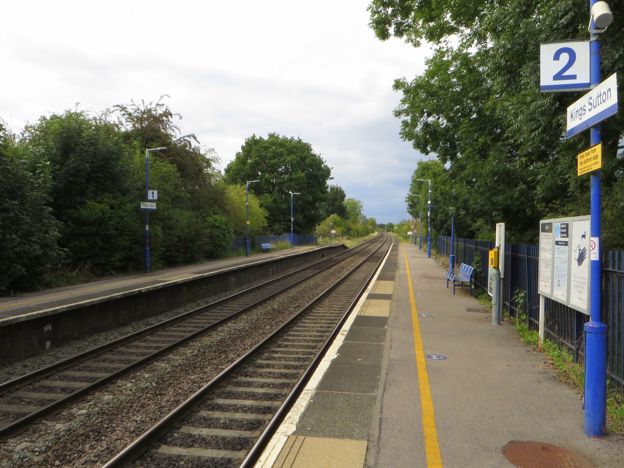
Kings Sutton Railway Walk from the Station
Walk · Starts in Kings Sutton · 2 hrs · Circular
A 4.4-mile (7.1km) circular walk from Kings Sutton station on the parish's own Railway route, easy to moderate and about two hours. It climbs through the village past the spire, crosses fields north, and returns over the railway line on foot by the old Bog Spring.
Stay and eat near Adderbury House
-
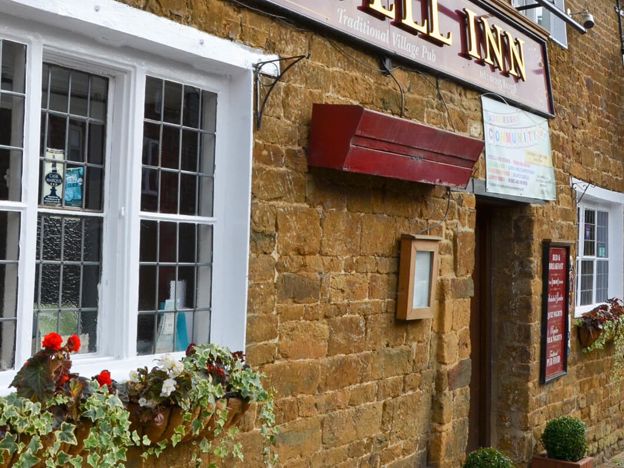
The Bell Inn, Adderbury
Pubs · Adderbury
Adderbury's traditional Hook Norton inn on the High Street, near St Mary's Church, with a suntrap garden, curry on Tuesdays, sourdough pizza on Fridays and stuffed Yorkshires on Sundays.
Dog-friendly
Verified Nov 2026
-
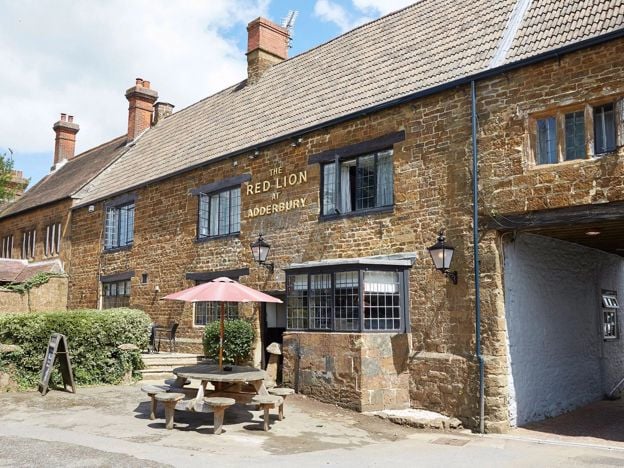
The Red Lion, Adderbury
Pubs · Adderbury
A Grade II listed Greene King pub and inn on The Green at Adderbury, serving food from breakfast to 9pm every day, with a car park, a beer garden and rooms.
Dog-friendly · Family-friendly
Verified Nov 2026
-
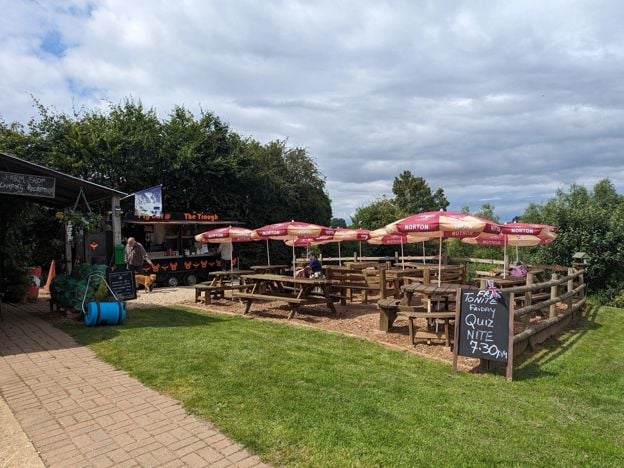
The Pig Place, Adderbury
Camping · Adderbury
A rustic, adults-only campsite beside Nell Bridge Lock on the Oxford Canal near Adderbury, with dogs free, off-lead space, pitches from £12, and a café, bar and music in summer. No showers.
Dog-friendly · Walker-friendly
Verified Nov 2026
More sights to see
-
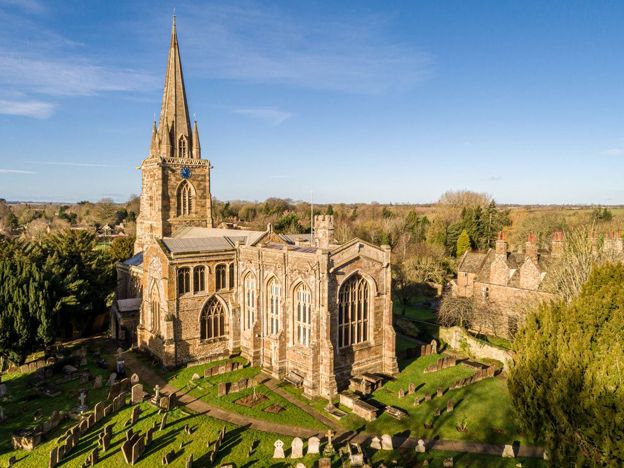
St Mary's Church, Adderbury
Sight · Church · Adderbury
Adderbury's Grade I church, with a stone spire, a frieze of medieval musicians and grotesques round its aisles, and a chancel built by Richard Winchcombe for New College, Oxford. Open daily and free to look round.
-

Warriner Windmill, Bloxham Grove
Sight · Historic building · Bloxham
A small timber post mill on the high ground at Bloxham Grove, between Bloxham and Adderbury, built in 1865 by the engineer Henry Warriner as a memorial to all windmills. Grade II, with its machinery intact. On farmland, not open, and seen from a footpath nearby.
-
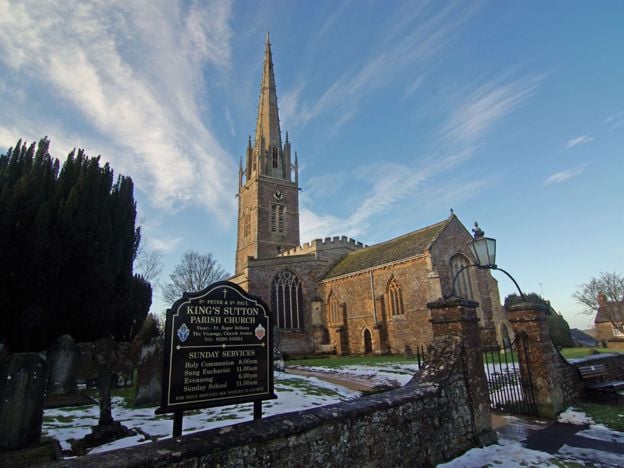
St Peter and St Paul's Church, Kings Sutton
Sight · Church · Kings Sutton
The Grade I church on The Square at Kings Sutton, whose crocketed spire of about 1370, given as about 60m, is the beauty in the old rhyme. Norman arcading, painted roof bosses and a Resurrection monument inside. Open in daylight.