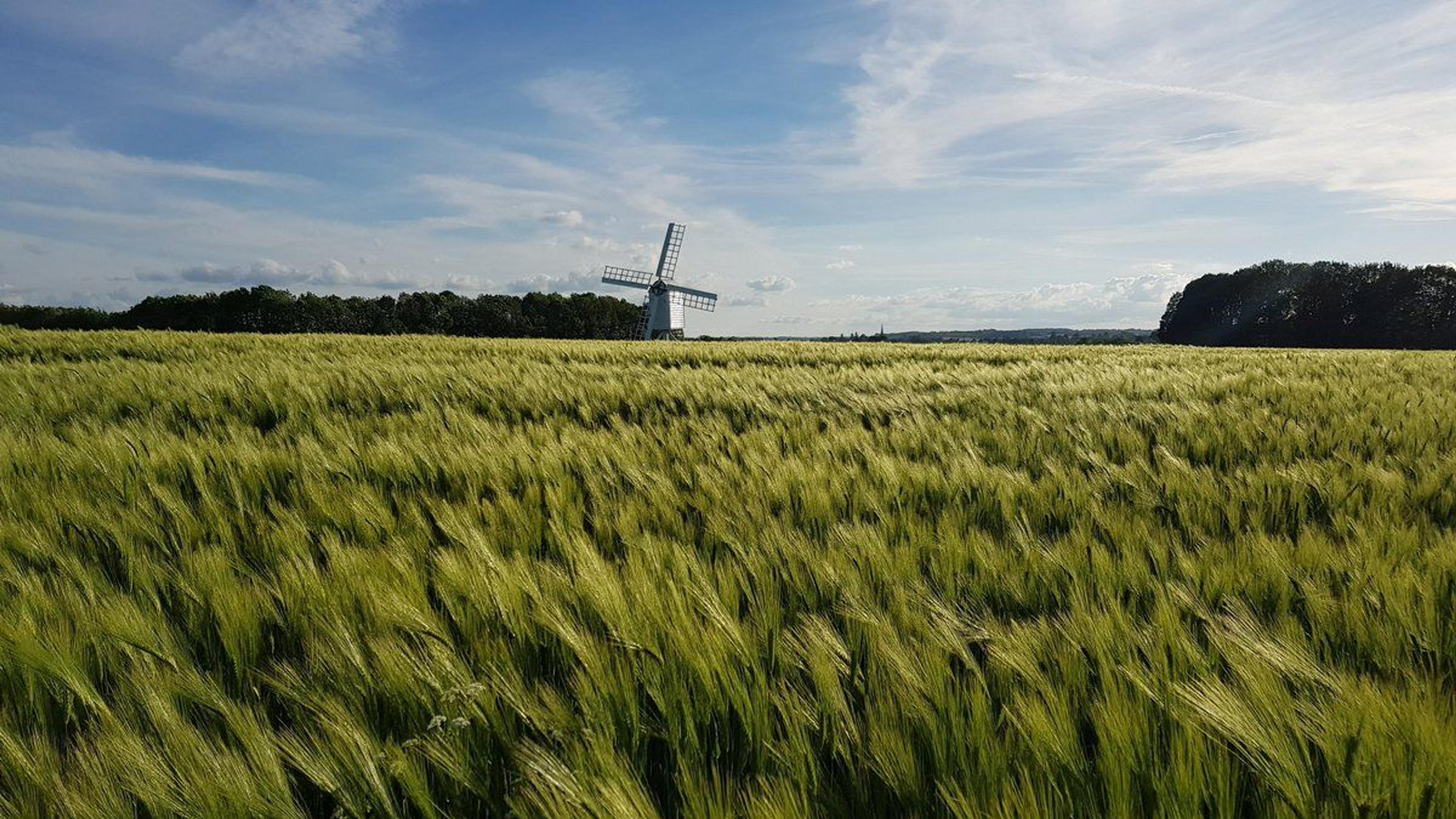
Warriner Windmill
The Warriner Windmill, also known as Bloxham Grove Windmill, is a unique Grade II listed post mill standing on the highest ground for miles around at Bloxham Grove Farm, about 200 metres south-west of the main farm complex. Built in 1865, this charming one-third scale windmill was constructed not for commercial purposes, but as 'a memorial to all windmills' by Henry Warriner, a Victorian engineer who clearly appreciated that in an age of steam power, traditional windmills had had their day. The mill survives in excellent condition with its machinery intact and remains a very visible reminder of the initiative and vision of its creator. The windmill is outwardly conventional in form, featuring four sails covered by cloth rolled down the sail frames, a weather-boarded, gable-roofed wooden 'buck' or body containing the machinery, and its main post supported by iron-strapped cross-trees set upon stone- and concrete-capped tapering brick piers. To the rear of the body is a pair of doors with iron strap handles. The traditional white paintwork with black metalwork makes it a striking landmark visible from considerable distances across the North Oxfordshire countryside. Inside, the machinery comprises one pair of 30-inch millstones, driven directly from above via a wooden gear wheel with 48 cogs. A governor is suspended beneath the stones, which are fed from a detachable hopper. The technical design reflects Henry Warriner's engineering expertise, with sail angles carefully calculated for optimal performance at this reduced scale. The sails have specific angles - approximately 3.6 degrees at the tip and 16.4 degrees at the heel - calculated to provide optimal performance for the small millstones. The mill was designed to operate at around 110 RPM at the stones, which equates to about 30 RPM at the sails, with a sail tip speed of 25 miles per hour - similar to many full-size mills despite its reduced scale. The story of the Warriner Windmill is intimately connected with the history of agricultural improvement in Bloxham. Around 1797, coinciding with the enclosure of the parish's open fields in 1794 and 1802, George Warriner (I) purchased and united the Old Farm (204 acres) and New Farm (147 acres) at Bloxham Grove. This enclosure movement created the modern agricultural landscape we see today, transforming medieval open field systems into the patchwork of hedged fields characteristic of the English countryside. George Warriner's son, also named George Warriner (II), was an improving farmer whose progressive activities were noted by Arthur Young, the famous agricultural writer, when he reported on agriculture in Oxfordshire in 1809. Young's observations, published in 1813, highlighted Warriner as an exemplar of the new scientific approach to farming that was transforming British agriculture. Symptomatic of this forward-thinking approach was Warriner's purchase of threshing and winnowing machines mentioned in an inventory of 1813, the rebuilding of some of the farm's buildings in 1826, and subsequently the installation of a steam engine in the barn to drive milling machinery. The investment in steam power may have been at the instigation of the younger Warriner's nephew Henry Warriner (1819-1902), an engineer who was employed along with his brother George to manage the farm. Henry Warriner was a gifted mechanical engineer whose career encompassed both marine and railway engineering. He was clearly a man who enjoyed experimenting with motive power and new technologies. In 1841, for instance, he built and launched 'The Firefly', an experimental steam launch, demonstrating his innovative spirit and practical engineering skills. Another of Henry's enthusiasms was windmills, and in 1865, when serving as chief engineer of Messrs Maudslay Sons and Field of Lambeth, a prestigious engineering firm, he designed the one-third scale post mill at Bloxham Grove. According to his nephew, who was interviewed in 1957, Henry 'spent many a windy day in it when on holiday. It was of course a hobby and not big enough for commercial work'. The mill's construction as a memorial reflects a poignant awareness of technological change - Henry understood that steam power was rendering traditional windmills obsolete, and he wanted to preserve the memory and craftsmanship of these elegant machines for future generations. The mill (or its machinery) was said by Henry's nephew to have been made by John Lampitt and Co. of Banbury, a well-known local engineering firm, although elsewhere it is stated that it was the barn machinery which Lampitts made. One possibility is that the firm was responsible for both the windmill and the steam-powered barn equipment, representing the old and new technologies side by side. The Warriner family farmed Bloxham Grove until the late 19th century and owned the farm until 1916, maintaining a connection with the land that spanned more than a century. Since 2007, the mill has been carefully maintained and occasionally operated by a local group of enthusiasts led by Tim Rogers. Their dedicated conservation work has included replacing the tail ladder, inserting steel ties to diagonally brace the buck (which had become slightly 'head sick' or tilted), and fitting steel shackles to ensure the quarter bars and cross-tree joints remain secure. The mill was repainted in the traditional white with black metalwork, restoring its appearance to match historical photographs. A photograph taken by Colonel Norris in 1906, about three years before Henry Warriner's death, provides valuable documentation of the mill's original appearance and has guided restoration efforts. The mill's Grade II listing, granted on 25 June 2007, recognizes its special architectural and historic interest and ensures that this unique memorial to traditional windmills will be preserved for future generations. The windmill's prominent position on the highest ground for miles around makes it highly visible from surrounding areas, and it stands close to a public footpath, allowing walkers to appreciate this remarkable structure up close. The elevated location was deliberately chosen both for practical reasons - to catch the strongest winds - and for its visual impact as a landmark. Today, the Warriner Windmill stands as a beloved local landmark and a symbol of Bloxham's agricultural heritage. It has given its name to The Warriner School in Bloxham, whose logo features the distinctive silhouette of the windmill, ensuring that Henry Warriner's memorial continues to be recognized and celebrated by new generations. The windmill serves multiple roles in the community - as a historic monument, an educational resource about traditional milling and agricultural history, and a picturesque feature of the North Oxfordshire landscape. For visitors walking the footpaths around Bloxham Grove, the windmill offers a tangible connection to Victorian England's agricultural and engineering history. It stands as a testament to Henry Warriner's vision in creating a memorial that would outlast the working windmills it commemorates, and to the dedication of modern volunteers who ensure this unique structure continues to turn its sails in the Oxfordshire breeze, just as Henry intended over 150 years ago.